
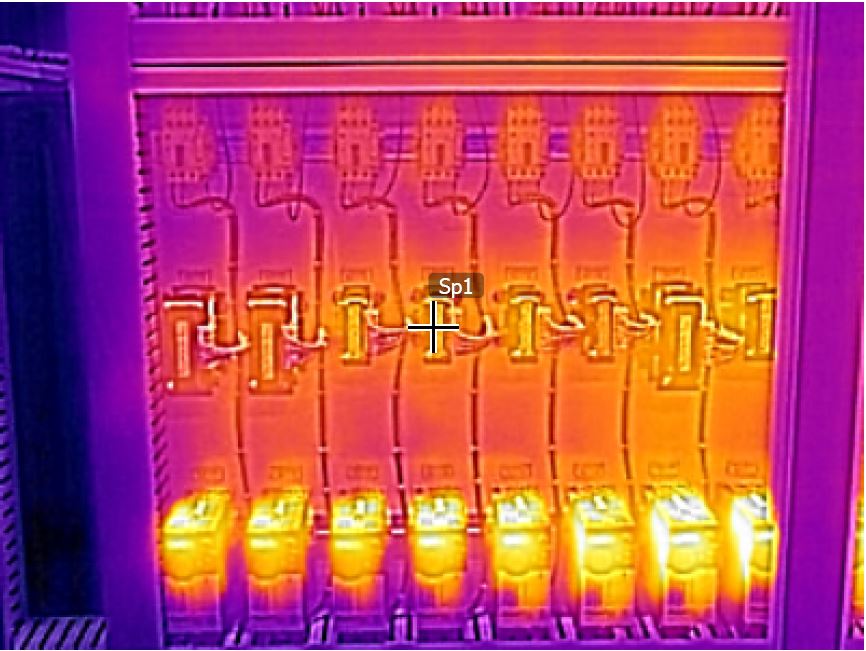
Infrared thermography provides a non-contact view of surface-temperature patterns that can support building-envelope, mechanical, electrical, equipment, process, and diagnostic investigations.
On-Site Acoustic Testing uses FLIR thermal imaging as a field-investigation tool where temperature distribution, thermal anomalies, or changes under different operating conditions may help identify a problem or document performance.
FLIR Thermal Imaging and Surface-Temperature Mapping
Thermal images can show temperature patterns that are difficult to identify with conventional visual inspection alone. Depending on the project, OSAT can document surface-temperature differences, anomalous hot or cold areas, equipment operating patterns, and changes observed before and after corrective work.
Mechanical, HVAC, and Equipment Investigations
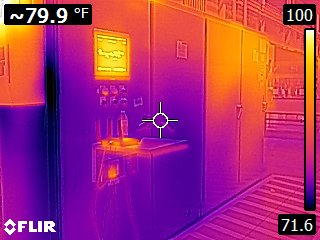
Thermography can be useful when investigating HVAC systems, air handlers, pumps, fans, motors, piping, rooftop equipment, generators, cooling equipment, and other accessible machinery or process surfaces. Thermal patterns can be compared between components or operating conditions to help identify areas that warrant additional investigation.
Building Envelope and Construction Investigations
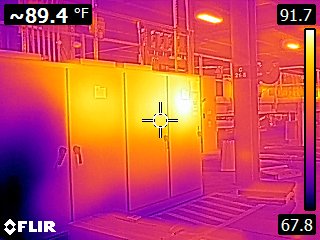
Thermal imaging can identify temperature anomalies at walls, ceilings, windows, doors, penetrations, and other envelope or construction elements. These patterns may be associated with insulation discontinuities, air movement, thermal bridging, moisture-related conditions, or other construction differences, although interpretation depends on site conditions and should be correlated with other observations or measurements as appropriate.
Electrical and Accessible Equipment Surfaces
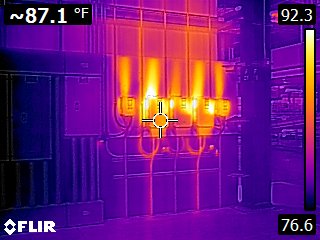
Infrared imaging can document unusual temperature patterns at accessible electrical panels, connections, and equipment surfaces without physical contact. OSAT uses thermography as a screening and documentation tool rather than as a substitute for electrical inspection, electrical safety evaluation, or trade-specific diagnostic work.
Data Center Thermal Investigations
For data centers and other mission-critical facilities, FLIR imaging can supplement noise and vibration work by documenting surface-temperature patterns at cooling equipment, air-handling systems, electrical and mechanical equipment, and other accessible infrastructure. Testing can include operating-condition comparisons, anomalous hot or cold areas, and before-and-after documentation associated with troubleshooting or corrective work.
Before-and-After and Comparative Testing
Where conditions can be reproduced, thermal images can be collected before and after repairs, adjustments, mitigation, or operating changes. Comparative imaging can provide a useful visual record of how surface-temperature patterns changed under the documented conditions.
Thermography as Part of a Broader Investigation
Infrared thermography does not directly measure sound leakage, vibration, electrical integrity, airflow, or moisture. It is most useful when thermal observations are interpreted alongside the appropriate field measurements and site information. For acoustic investigations, thermal imaging can provide supplementary information about construction discontinuities, while sound leakage itself should be confirmed using appropriate acoustic measurement or source-localization methods.
Independent Field Documentation
Reports can incorporate selected thermal images, visible-light photographs where useful, measurement conditions, observed temperature patterns, and technical interpretation appropriate to the scope of the investigation.
Discuss a Thermographic Investigation
Provide the building or equipment type, suspected condition, operating state, project location, and intended use of the results.
