
On-Site Acoustic Testing provides long-term noise and vibration monitoring for construction, industrial, commercial, residential, transportation, data center, and other projects where conditions need to be documented over days, weeks, months, or longer periods.
Related services include data center noise and vibration testing and environmental noise surveys and noise-control consulting.
Long-term noise monitoring
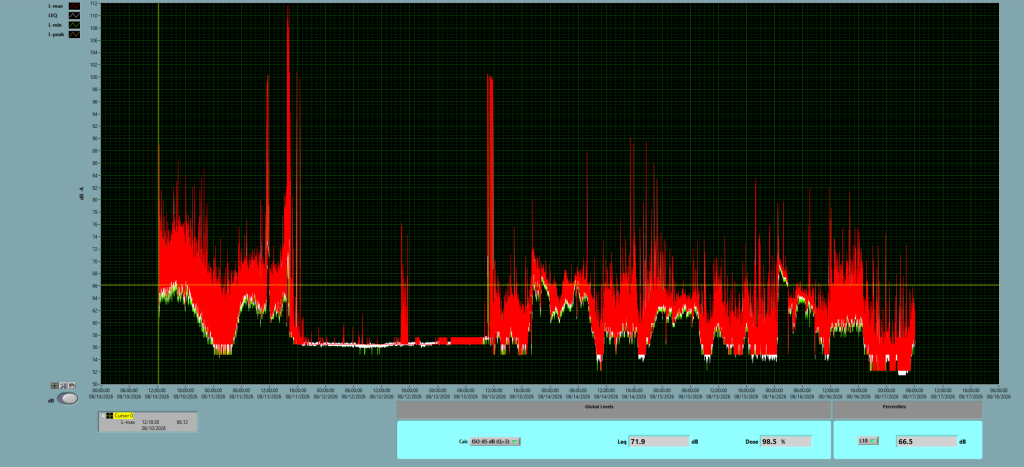
Continuous or unattended noise monitoring can document changing sound levels, recurring events, operating cycles, nighttime conditions, and other patterns that may not be captured during a short site visit.
- Environmental and community noise monitoring
- Construction-noise monitoring
- Industrial and facility noise monitoring
- Property-line and neighborhood measurements
- Nighttime and low-background-noise conditions
- Octave-band and one-third-octave-band data where required
- Event identification and time-history documentation
Long-term vibration monitoring
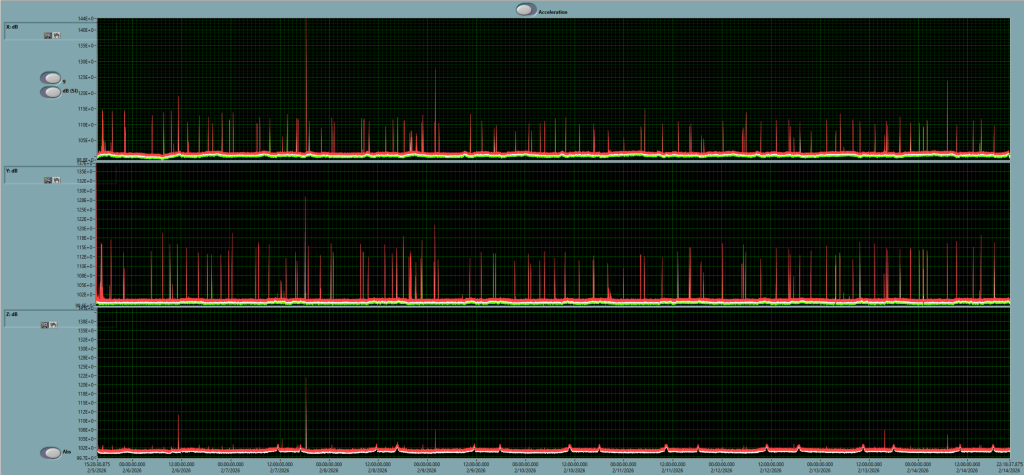
Vibration monitoring can be used to document equipment operation, construction activity, structural response, recurring disturbances, and changes over time. Projects can include continuous logging, event-based review, or comparative measurements before, during, and after an activity.
- Building and structural vibration
- Construction and excavation activity
- Machinery and rotating equipment
- Mechanical-system and equipment vibration
- Multi-axis vibration logging
- Frequency-domain review where applicable
- Baseline and post-mitigation comparison
How Monitoring Programs Are Structured
The monitoring plan is built around the event or operating condition that needs to be documented. OSAT establishes the measurement locations, parameters, logging interval, trigger or event criteria where applicable, and the operating or construction information needed to interpret the data. Baseline measurements can be collected before an activity begins so later changes can be compared with a known starting condition.
For longer assignments, interim data review can be used to confirm that the instrumentation is capturing the relevant events and to identify patterns while the program is still active rather than waiting until the end of the deployment.
Remote monitoring
For suitable projects, OSAT can deploy remote noise and vibration monitoring systems that allow data to be reviewed without a technician remaining on site. Remote monitoring can operate through site Wi-Fi where available, and cellular connectivity can be added when necessary. This supports longer monitoring periods, faster review of changing conditions, and more efficient investigation of intermittent events.
All monitoring records are time-stamped so measured events can be correlated with operating conditions, construction activity, complaints, or other site information. Automated warning emails can also be configured to notify designated recipients when noise or vibration levels exceed predetermined thresholds.
Where audible documentation is useful, OSAT can provide simultaneous time-stamped audio recording alongside the measurement data. This allows a measured event to be reviewed not only by level and time history, but also by the corresponding recorded sound.
- Remote review of logged noise and vibration data
- Monitoring over extended periods without continuous site staffing
- Time-history review and identification of recurring events
- Coordination with operating schedules, complaints, or construction activity
- Interim review during an active monitoring program
- Optional synchronized sound and video recording where appropriate to document events and site conditions
- Final reporting and technical interpretation
Typical applications
- Construction and demolition projects
- Data centers and mechanical plants
- Manufacturing and industrial facilities
- Residential, condominium, and HOA complaints
- Transportation and infrastructure projects
- Commercial and institutional facilities
- Pre-construction and baseline documentation
- Verification after mitigation or equipment changes
What Clients Receive
Depending on the project, deliverables can include time-history plots, summary sound or vibration metrics, event logs, frequency data, monitoring locations, instrument and setup information, photographs, operating or construction timelines, comparisons with applicable criteria or baseline conditions, and technical interpretation of significant events. For extended programs, interim summaries can be provided before the final report.
Independent field documentation
OSAT is an independent testing company. We document actual field conditions, operating periods, instrumentation, measurement locations, and relevant project criteria so the results can be used for troubleshooting, compliance review, project management, commissioning, acceptance, or dispute resolution.
