
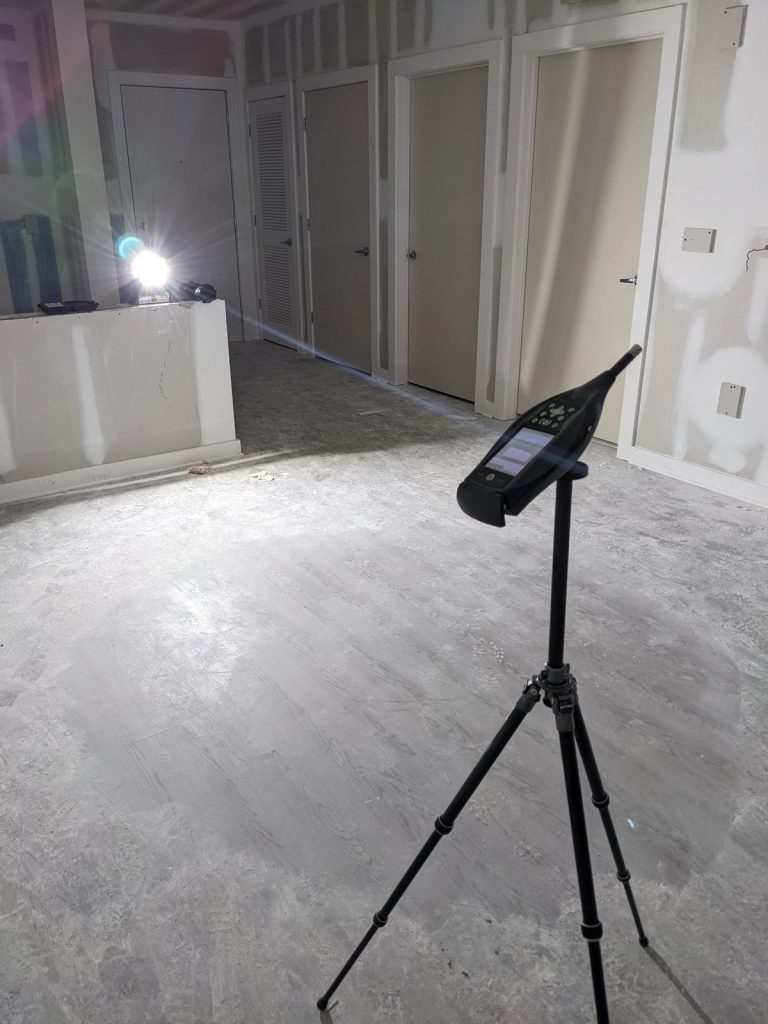
Field testing of installed building assemblies for airborne sound isolation, impact sound isolation, exterior façade performance and reverberation.
On-Site Acoustic Testing provides building acoustics field testing throughout the United States and internationally for government and military facilities, architects, engineers, contractors, developers, building owners and property managers. Testing is performed using applicable ASTM and ISO procedures with dedicated building-acoustics instrumentation.
Field results that inform building-acoustics decisions
OSAT tests installed floor, ceiling, wall and door assemblies, helping clients understand actual airborne and impact sound transmission rather than relying on material ratings alone.
- Apartment development: comparisons of multiple floor-ceiling assemblies informed standardized construction details.
- Eight-property apartment portfolio: field sound-isolation measurements supported flooring and acquisition decisions.
- Broadcast enclosures: acoustic verification supported improvements to door isolation.
See the assembly comparison, portfolio assessment and broadcast pod study.
Building Acoustics Field Testing
Building-acoustics testing evaluates the performance of the completed, installed construction rather than relying only on laboratory ratings or design assumptions. Field results reflect the actual walls, floors, ceilings, doors, façades, penetrations, junctions and flanking paths present at the project site.
What We Test
- Demising walls and partitions between rooms, units and occupancies
- Floor/ceiling assemblies for airborne and impact sound isolation
- Doors, frames, seals, glazing and other openings
- Exterior walls, windows, doors and façade systems
- Rooms where reverberation and sound decay affect speech, music or usability
- Completed assemblies that have failed a specification, generated complaints or require acceptance testing
Field measurements can be used to verify completed construction, document compliance with project criteria, investigate sound-isolation problems and identify assemblies or transmission paths requiring corrective work. OSAT provides testing for commercial, residential, institutional, government and secure-facility projects.
ASTC – Apparent Sound Transmission Class
ASTM E336 field measurement of airborne sound isolation across installed walls, floor/ceiling assemblies and other separating partitions. ASTC and related field metrics include the effects of the installed construction and flanking transmission.
AIIC – Apparent Impact Insulation Class
ASTM E1007 field measurement of impact sound transmission through installed floor/ceiling assemblies using a standardized tapping machine. AIIC testing is commonly used for multifamily residential construction, flooring evaluations and investigations of impact-noise complaints.
Understanding product ratings? See the OITC rating guide, charts and STC comparison.
OITC, AOITC and OINIC – Exterior Façade Testing
ASTM E966 field testing characterizes outdoor-to-indoor sound attenuation of installed exterior walls, windows, doors and façade systems. Depending on the measurement method and field conditions, results can be used to develop OITC/FOITC, AOITC or OINIC ratings.
Reverberation Time (RT)
Reverberation-time measurements characterize sound decay within an enclosed space. RT measurements are used as part of several building-acoustics field procedures and can also be performed independently to evaluate room acoustics for speech, music and other uses.
How Field Testing Is Performed
The test setup depends on the assembly and the applicable method. In a typical sound-isolation test, calibrated source and receiving-room measurements are made at multiple microphone positions, background noise and room conditions are documented, and the data are reduced to the required field rating. Impact testing uses a standardized tapping machine on the floor assembly, while façade testing uses exterior and interior measurements appropriate to the selected method.
Where the purpose is troubleshooting rather than simple acceptance, OSAT can vary source position, inspect likely leakage locations, compare adjacent assemblies, and test suspected flanking or bypass paths to determine why the installed result differs from the expected performance.
Current Building Acoustics Instrumentation
OSAT maintains dedicated field equipment including precision acoustic analyzers, standardized tapping machines and omnidirectional sound sources. Battery-powered instrumentation also allows measurements in locations where normal power or conventional access is impractical.
Troubleshooting, Remediation and Retesting
When an assembly does not meet its required performance, the numerical rating alone is only part of the answer. OSAT can help identify likely leakage, flanking, sealing, fitment or construction issues and provide measurement-based feedback while corrective work is being developed. After repairs are completed, the same assembly can be retested to verify the result.
Government, Commercial and Residential Projects
For commercial-building owners, developers, architects and contractors, see our commercial acoustics testing and independent building-performance verification overview, including commissioning, diagnostic investigation and retesting.
Our building-acoustics work includes U.S. military and federal facilities, secure facilities, commercial and industrial buildings, multifamily housing, condominiums and other projects where installed acoustic performance must be measured objectively in the field.
What Clients Receive
Depending on the assignment, deliverables can include the applicable field ratings, frequency-by-frequency results, test locations and assembly descriptions, measurement conditions, photographs and field observations, comparison with project criteria, and identification of likely deficiencies or transmission paths. Retesting results can be documented alongside the original measurements to show the effect of corrective work.
Laboratory Ratings Versus Installed Building Performance
Laboratory STC and IIC values describe assemblies tested under controlled conditions; installed buildings can behave differently because of flanking paths, penetrations, construction details and workmanship. OSAT uses applicable field procedures, including ASTM E336 for airborne sound isolation and ASTM E1007 for impact sound measurements, with ratings calculated under the relevant classification standards. See our full field testing services for related measurement programs.
Discuss Your Building Acoustics Testing Requirements
Contact On-Site Acoustic Testing to discuss the building assembly, project criteria, site conditions and field measurement required.
