
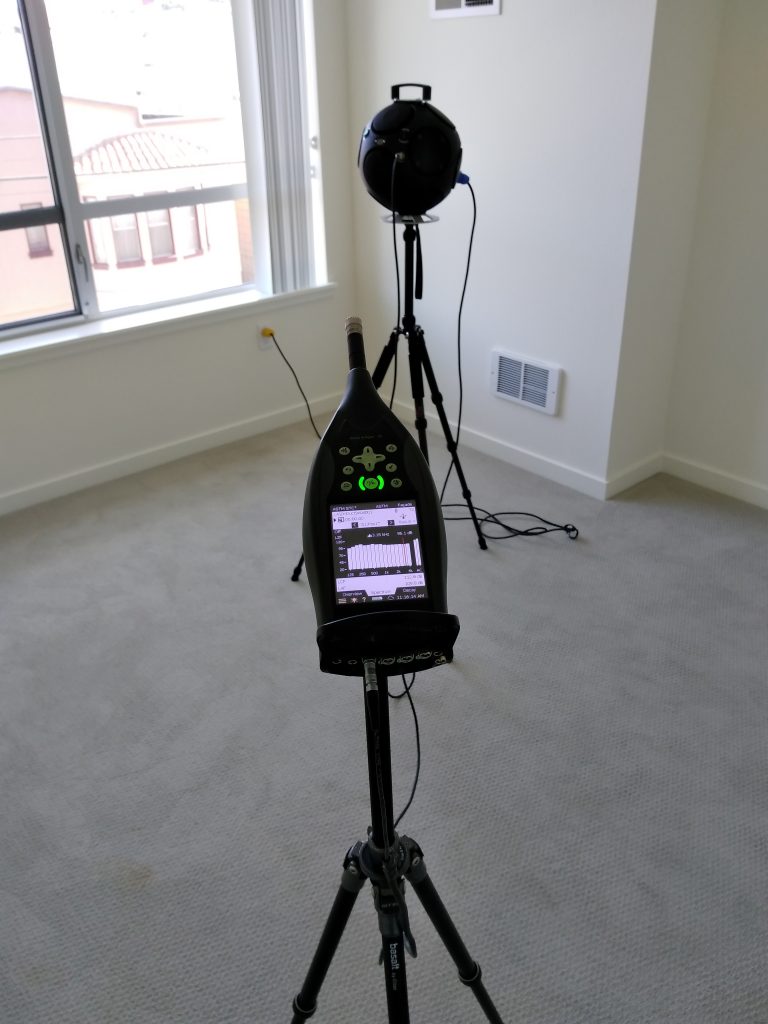
On-Site Acoustic Testing performs ASTM E336 field measurements of airborne sound isolation between rooms and across installed partitions, including ASTC, NIC and related field metrics.
ASTM E336 Airborne Sound Isolation Testing
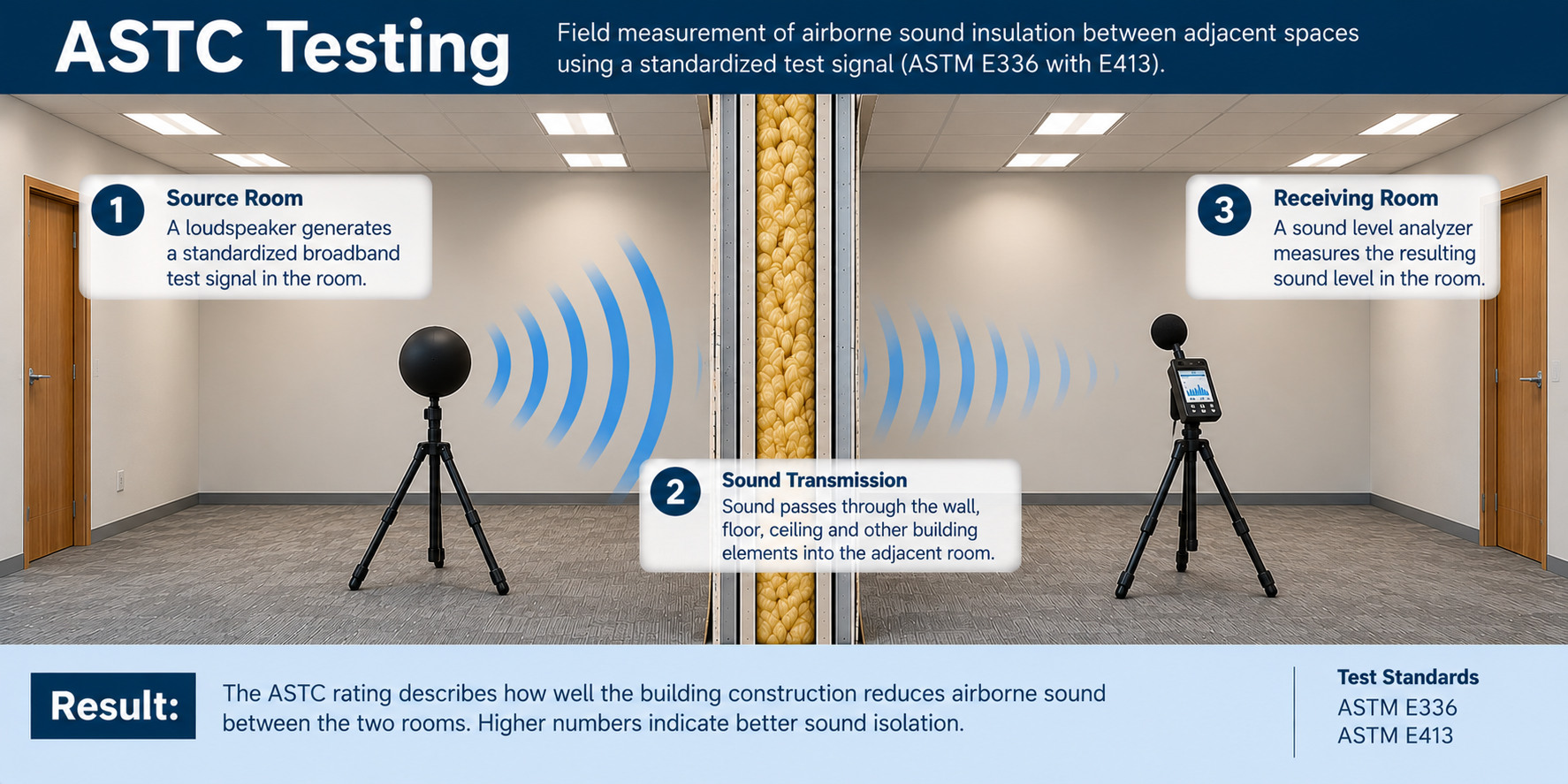
Apparent Sound Transmission Class (ASTC) describes the apparent sound insulation of an installed separating partition. Unlike a laboratory STC measurement of an isolated construction, an ASTC field result includes the influence of direct transmission and flanking transmission through the supporting building structure.
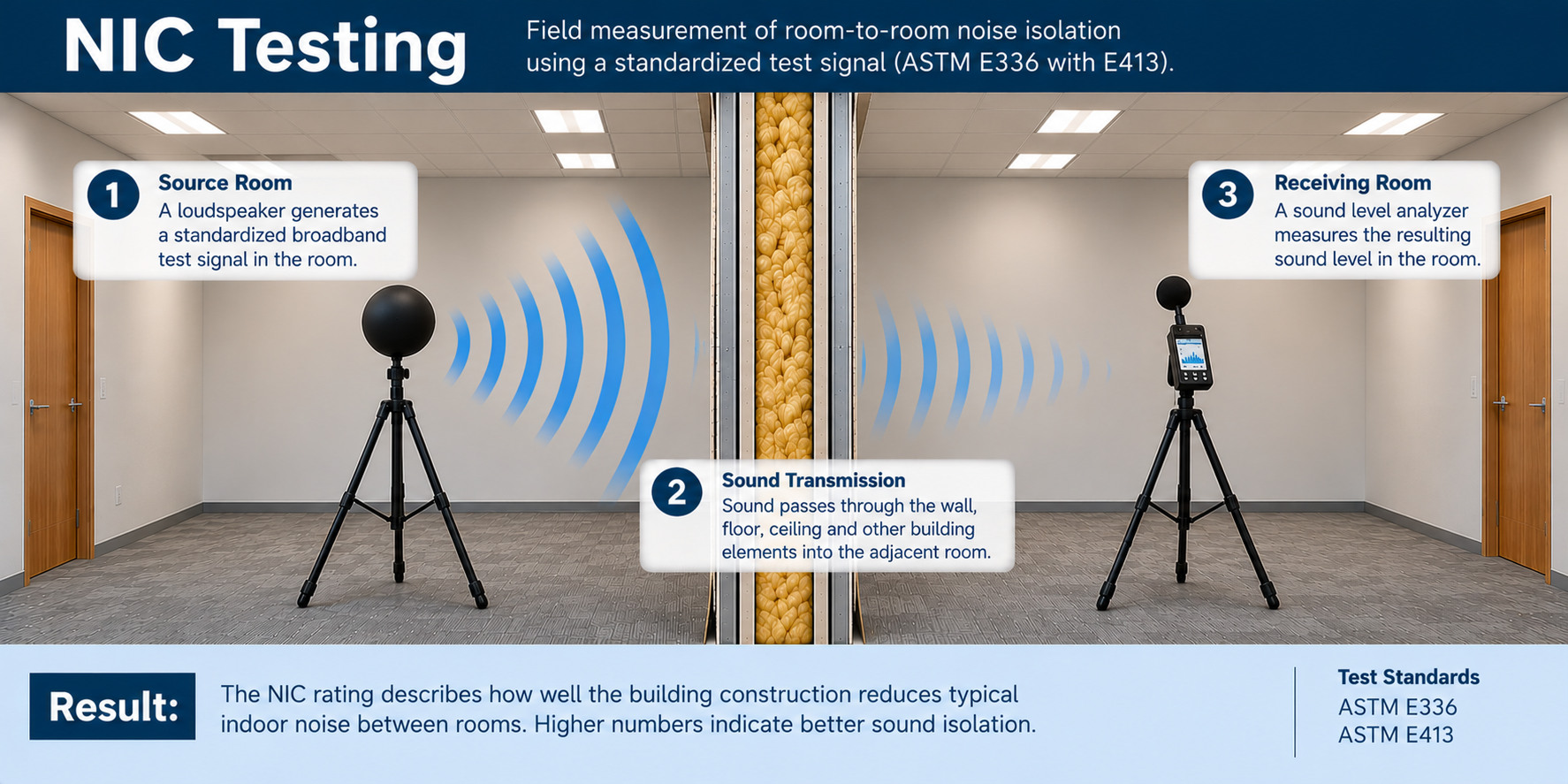
ASTM E336 also provides other field metrics, including Noise Isolation Class (NIC) and Normalized Noise Isolation Class (NNIC). The appropriate metric depends on the spaces, construction, project requirement and purpose of the measurement.
NIC Field Measurement
STC Rating vs. ASTC Field Testing
Customers frequently request STC testing for completed walls and partitions. STC commonly describes laboratory sound isolation of an assembly; ASTC measures apparent sound isolation of installed construction, including flanking transmission. ASTM E336 field measurements may also produce NIC and other metrics. Laboratory STC ratings do not guarantee the same field rating after installation.
When to Request Field Sound Isolation Testing
Typical applications include hotels, office suites, healthcare spaces, multifamily construction, commissioning, and noise complaints. OSAT selects the measurement and rating according to the project criteria. See commercial acoustics testing for related services.
Field Test Equipment
Testing requires a suitable broadband sound source in the sending room and precision sound-analysis equipment in the receiving room. OSAT maintains dedicated building-acoustics instrumentation, including omnidirectional sound sources and current-generation analyzers, for measurements in accordance with applicable ASTM and ISO procedures.
Measurements can be used for acceptance testing, troubleshooting, investigation of sound-isolation complaints, verification of completed construction, and comparison with project acoustical criteria.
Walls, Floor/Ceiling Assemblies, Doors and Other Partitions
ASTM E336 applies to installed boundaries separating spaces, including walls and floor/ceiling assemblies. OSAT can also perform diagnostic measurements where the objective is to identify weak paths, flanking transmission or construction details that are limiting overall sound isolation.
Related Building Acoustics Testing
- Building acoustics testing services
- AIIC impact sound testing
- ASTM E966 façade, window and door testing – OITC, AOITC and OINIC
Discuss Your Sound Isolation Testing Requirements
Contact On-Site Acoustic Testing to discuss the construction, project criteria and field sound-isolation metric appropriate for your project.
